
Announcing the 2025-26 Donner Prize Winner
Winner
Borderline Chaos: How Canada Got Immigration Right, and Then Wrong by Tony Keller (Sutherland House Books)
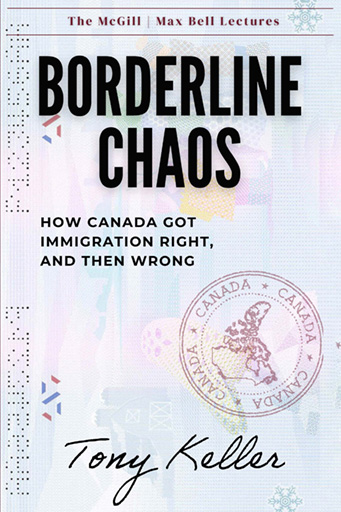
How did Canada turn one of its most admired policy achievements into a source of public anger and institutional damage? Tony Keller’s Borderline Chaos answers that question with precision and force. In sharp, concise prose, it traces how a once-stable, broadly trusted, rules-based immigration system, built on skilled permanent residents and disciplined selection, was overtaken by a coalition of business interests, provincial incentives, and federal political ambition. The result is incoherence, housing strain, labour-market distortion, and eroded public confidence. Jurors celebrated the book’s clarity of thesis and its insistence on evidence-based policymaking, calling it compelling and infuriating in equal measure — essential reading for any policymaker confronting the aftermath of that period.
Tony Keller is a columnist for the Globe and Mail and a National Newspaper Award winner with more than 30 years in Canadian journalism, including roles as editorial board chair at the Globe and managing editor of Maclean’s.
Runners-Up
Breaking Point: The New Big Shifts Putting Canada at Risk by Darrell Bricker and John Ibbitson (Signal)
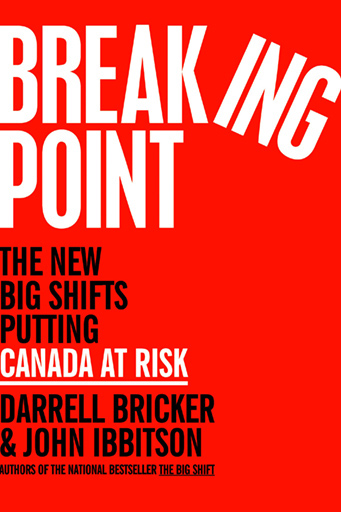
Canada is not collapsing — but it is bending. Breaking Point makes a compelling case that the pressures accumulating around housing, productivity, regional grievance, immigration mismanagement, and generational inequality are converging in ways that threaten national cohesion. Bricker and Ibbitson’s great strength is synthesis: they pull together disparate anxieties into a single, coherent story about national fragility. Grounded in polling data, demographic trends, and economic indicators, including long-term survey data showing declining national pride, the book offers decision-makers both a lens on public mood and a strategic overview of the risks Canada faces if current trends continue. Jurors praised it as a timely and accessible contribution that translates complex policy debates in a way everyday Canadians can appreciate.
Darrell Bricker is CEO of Ipsos Public Affairs and a Senior Fellow at the Munk School of Global Affairs at the University of Toronto; he previously served as director of public opinion research in the office of the prime minister of Canada.
John Ibbitson is an award-winning author, and former writer-at-large for the Globe and Mail, having also served as chief political writer, political affairs columnist and bureau chief in Washington and Ottawa.
21 Things You Need to Know About Indigenous Self-Government: A Conversation About Dismantling the Indian Act by Bob Joseph (Page Two)
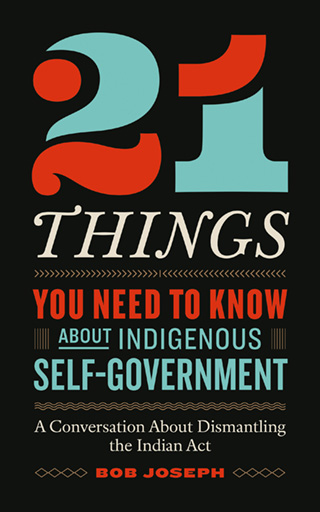
One of the central unresolved questions in Canadian public life is how to move beyond the Indian Act. Bob Joseph’s focused volume takes that question seriously and answers it with clarity, conviction, and practical grounding. Structured around 21 short chapters, it demystifies the core concepts of jurisdiction, inherent rights, fiscal arrangements, and treaty relationships, without the use of legal jargon or rhetorical excess. Drawing on real policy mechanisms and case studies such as the Nisga’a and Westbank agreements, Joseph frames self-government not as a grievance-based claim but as a governance reality already in motion. Jurors praised its plain-language accessibility as making it a uniquely effective public education tool and noted that it lays out the issues and possible solutions more clearly and accessibly than any comparable work for Canadian readers.
Bob Joseph is a bestselling author and president of Indigenous Corporate Training Inc.; he has provided training on Indigenous relations since 1994. Joseph is a hereditary chief of the Gwawa’enuxw Nation, one of the eighteen tribes that make up the Kwakwakaʼwakw.
A New Blueprint for Government: Reshaping Power, The PMO, and the Public Service by Kevin G. Lynch and James R. Mitchell (University of Regina Press)
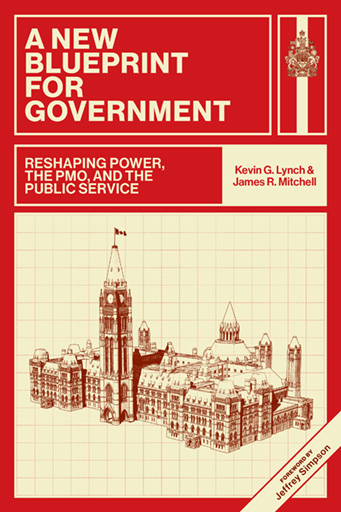
Canada’s policy underperformance is not simply a matter of ideology or bad luck, rather it is a structural problem, rooted in how the federal government is designed, managed, and held to account. Drawing on decades of senior public service experience, Lynch and Mitchell make a rigorous, evidence-based case that power has drifted dangerously from Cabinet to the PMO, that ministerial accountability has eroded, and that bureaucratic risk aversion has hollowed out execution capacity. In under 200 pages, they connect governance architecture to tangible failures — procurement delays, productivity stagnation, service breakdowns — and propose concrete reforms. Jurors described it as an elegantly argued agenda for change and the most focused, actionable detailing of possible Canada-focused policy reforms to emerge in recent years.
Kevin G. Lynch is a former Clerk of the Privy Council, Deputy Minister of Finance, and Deputy Minister of Industry, with a 33-year career in federal public service; he later served as Vice Chair of BMO Financial Group.
James R. Mitchell is an academic and senior public servant. He served 17 years in government, first as a diplomat and then as a senior official in the Privy Council Office and the Treasury Board Secretariat.
The Age of Extraction: How Tech Platforms Conquered the Economy and Threaten Our Future Prosperity by Tim Wu (Alfred A. Knopf)
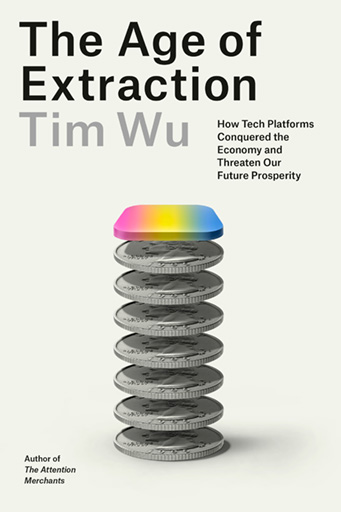
The promise of the digital economy was transformative — open, democratic, and generative of shared prosperity. Tim Wu’s The Age of Extraction is a bracing account of how that promise curdled. Drawing on a historically informed arc from oil trusts and railroad monopolies to Google, Amazon, and Meta, Wu argues that dominant platforms have stopped enabling markets and started extracting from them, harvesting data, imposing fees, manipulating algorithms, and eliminating competition. His central concept of “extraction” gives policymakers a disciplined framework for understanding digital concentration not as a technology story but as a story about power. Jurors found the book timely, intellectually rigorous, accessible, and strategically important. While its policy prescriptions are anchored in the U.S. context, its framework speaks directly to the platform challenges facing Canadian competition policy, digital regulation, and the future of work.
Tim Wu is the Julius Silver Professor of Law, Science and Technology at Columbia Law School. In 2021, he was appointed to serve in the White House as special assistant to the president for technology and competition policy.